“This ship will sink.”
My Substack metrics remind me of a famous line from the movie Titanic. Regarding the macro picture, I wonder if Substack might be in danger of floundering due to rapidly-increasing rates of inflation.

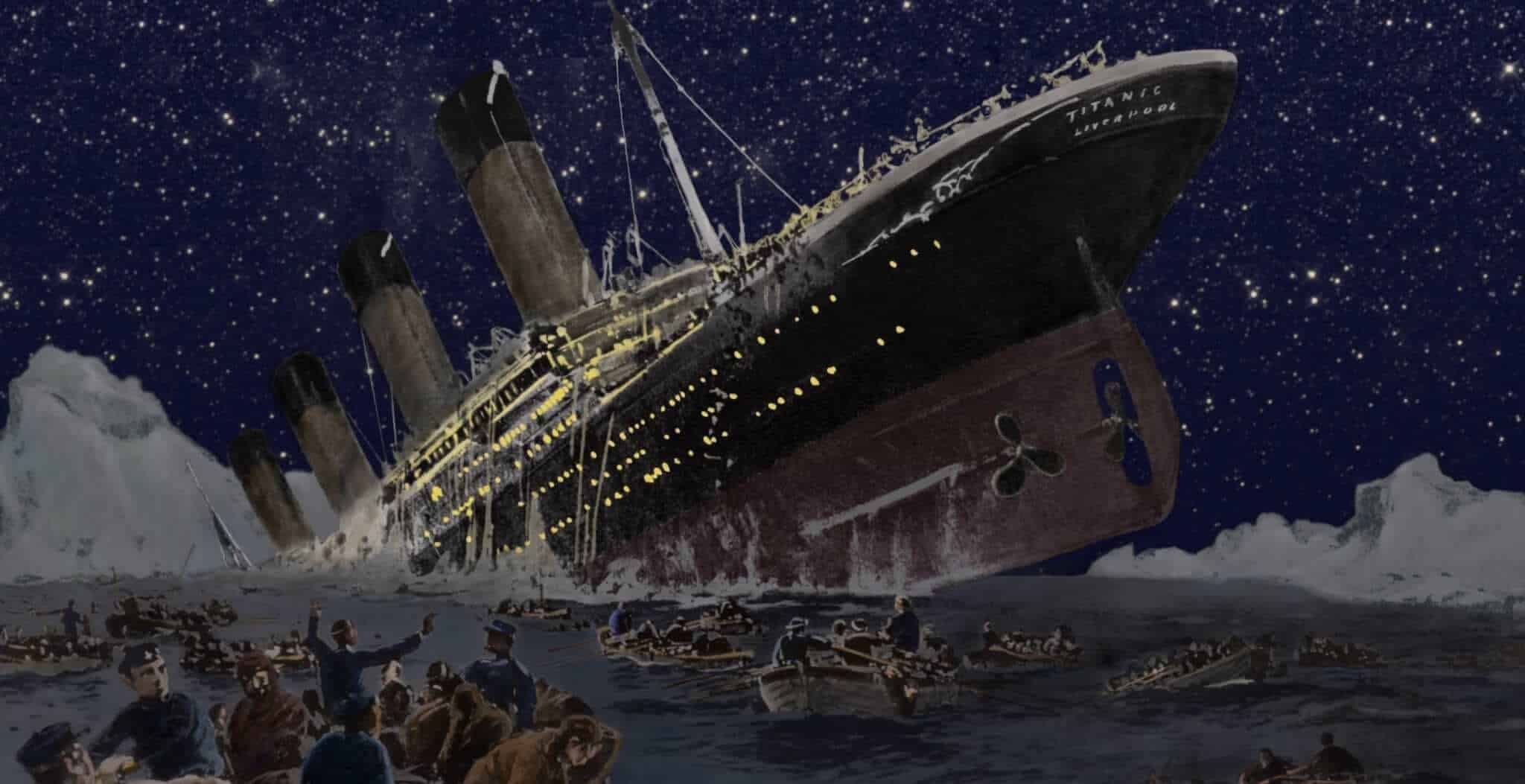
In the 1997 movie Titanic, ship architect Thomas Andrews tells Rose, “The ship will sink. ... In an hour or so, all of this will be at the bottom of the Atlantic.”
Earlier, when the ship line’s owner Bruce Ismay tells Andrews that the ship cannot sink, Andrews famously replies, “She’s made of iron, sir! I assure you, she can. And she will. It’s a mathematical certainty.”
***
Our family recently re-watched Titanic as my 10-year-old son, Jack, had never watched it all the way through and has recently taken an interest in the most famous ship disaster in history.
While viewing the scenes depicted above, I couldn’t help but think of my Substack newsletter, which in my assessment is also destined to sink. In my view, this bleak outcome is also probably “a mathematical certainty.”
Below I’ll provide a few recent Substack-provided metrics that inform and support this assessment/prediction.
However, before I come to a micro case study of one “Covid Contrarian” author, I want to share my thoughts and some predictions dealing with the macro picture and trends which I think will affect all Substack authors.
First, I must highlight other extremely bleak (or scary) figures … namely rapidly-rising price inflation.
In my assessment, this macro-economic data or trends could portend disaster for Substack (and all of its content creators) as the company and more than 17,000 of its best-known authors depend entirely on revenue from paid subscriptions.
Noted and for example ….
Since the start of the Iran War on February 28, average gas prices in America have increased from $2.98/gallon to $4.56/gallon - an increase of $1.58/gallon or 53 percent in approximately two months.
In the same two months, diesel prices have increased from $3.76/gallon to $5.66/gallon today - an increase of 77.1 percent.
As gasoline, and especially diesel prices, affect the price of every product manufactured and shipped to final users, prices for virtually every product in the world are currently rising and, according to many economists, will surge far more in coming months (even if the war soon ends and the Strait of Hormuz is “opened.”)
As many people now know, the price of fertilizer has also dramatically increased in the past two months, which many economic pundits say will, by this fall, cause major price increases in all foods that come from the earth’s soil.
If the war continues for several more months and the Strait remains closed for the same period of time, price levels of many foods and products will increase by levels perhaps never seen in our lifetimes. The worst-case scenarios might include “hyper inflation” in one or more nations and, possibly even a Great Depression.
Enter the work-around …
As I’ve documented in other articles, one of the easiest and most-common “inflation work-arounds” is to cancel, or dramatically reduce, paid subscriptions.
According to a Google AI query, the current average annual subscription rate for a Substack author is $96/year. (My annual price is $60/year but I know many popular newsletters charge $80/year).
Furthermore, a surprisingly tiny percentage of Substack subscribers provide the bulk of paid subscription revenue for this company and for content providers like myself.
While Substack’s PR information states that the platform has 5 million “paid subscriptions,” as far as I know the company has never disclosed how many distinct people pay for one or more Substack subscriptions.
Per my belief (based on research and feedback from readers and content creators), many Substack subscribers pay for multiple newsletters. That is, a typical paid subscriber on Substack might pay for five newsletters. If this guess is true, that would mean that maybe only 1 million users world-wide account for these five million “subscriptions.”
According to various sources, Substack currently has at least 35 million “users.” If only 1 million of these users are paying for subscriptions, this would mean that only 2.8 percent of Substack users provide the vast majority of Substack’s revenue.
If an average paid subscription is $80/year and it’s common for Substack’s paying customers to support five different authors, this would mean many of Substack’s most-generous benefactors are spending at least $400/year on paid subscriptions.
Common sense or logical deduction says that if half of these paying customers cut their subscription expenses in half, Substack would lose a tremendous amount of revenue/cash flow in the future (if inflation becomes even more alarming and more people decide they have to cut expenses wherever they can).
What would this scenario mean to Substack content creators and citizens who now receive much of their news or commentary from Substack?
Worst-case scenario, it might mean that the company Substack experiences a liquidity/revenue crisis and could, per my belief, possibly even go under. (Substack receives 10 percent of every paid subscription generated by its content creators).
If this happens, consumers interested in news, analysis, commentary and independent investigative journalism would lose access to a content platform tens of millions of global citizens enjoy and appreciate.
Also, this would occur after years and decades where corporate or “mainstream” news organizations implemented draconian cut-backs in staffing.
That is, even more (alleged) corporate “news” providers, who are already struggling to survive, might also go out of business or cut staffing (and thus content) by even greater degrees than has already occurred.
In times of, perhaps, increasing societal upheaval, members of the public would have even fewer sources to receive important news.
Below, I analyze the eye-opening and lucrative growth of novice Substack author Kait Justice. (This information should document the “exponential” growth of a rapidly-growing subset of Substack authors who, unlike myself, are not floundering. Instead, these are authors whose “ship has come in” in recent months and years on Substack.
Recently, Kait (who I profiled in January) stated in a Substack Note that:
“I have a feeling 2026 will be the year of independent reporting and journalism.”
While Kait’s optimistic POV might have been accurate for one ideological category of Substack authors and might have held true for the first months of this year, as I look toward the year 2027 and beyond, it might be more likely the public is going to be looking at the death of independent reporting and journalism - a result the Powers that Be might, perhaps, welcome and might even be working to produce.
Also, if “gloom-and-doom” inflation predictions materialize, it’s possible Substack’s founders will require a massive injection of working capital (via debt issuances) to continue to operate.
Or, if “narrative control” is considered to be vitally important to the world’s real rulers, it’s possible “someone” could clandestinely subsidize Substack via various means, which might ensure the site’s growing number of “narrative-protecting” authors can continue to file their stories. (In the view of at least some observers, such an arrangement might have already occurred as it regards “curious” subscriber spikes at certain mainstream news organizations (like maybe The Atlantic) and, perhaps, with many Substack authors.
Yet another possibility is that a billionaire narrative-protector or corporate media or social media company purchases Substack and, likely IMO, introduces paid advertising to produce new revenue streams for the company.
Still, “contrarian” or narrative-challenging authors like myself - who (see below) already feel like our ship might be going under - will almost assuredly face an even greater challenge to continue to produce investigative journalism or dissident commentary.
In fact, in the future, I can envision a Substack where the only authors who might continue to file original and significant dispatches will be authors who are somehow subsidized (perhaps by bots, perhaps by certain NGOs or by billionaire members of the Deep State ) … or who are independently wealthy and need no income for their writing … or who have spouses who generate sufficient income to support their better half.
That is, many genuinely-independent “citizen journalists” and citizen researchers who have flocked to Substack in recent years may be looking for a “real job” … at the worst-possible time if the country suffers through an extended recession or depression.
The rapid growth of AI, which is said to be a massive job-eliminator, is another concern for anyone entering tomorrow’s job market.
My metrics after hitting an iceberg …
With this macro overview/scenario outlined, I’ll now present a few of my recent subscriber metrics that illustrate the sea change in my own Substack newsletter in recent months.
Total (net) Paid Subscribers lost last 30 days; - 6 (from 243 to 237).
Average paid subscribers lost per month (current rate): 6
Total paid subscribers lost (net) last 12 months: - 44 (from 281 to 237)
Total Subscribers (free and paid) lost in last 37 days: - 287 (from 7,904 to 7,625).
Average of 7.6 lost subscribers/day.
Note:
My Total Subscribers peaked at 8,006 on July 21, 2025 (9.5 months ago). In the last 9 1/2 months, I have lost 381 (net) subscribers.
My “paid ratio” is now 3.1 percent. (For the first three or so years of my newsletter, this ratio was 4.7 percent).
Notices of “Email disabled from Bill Rice, Jr.’s Email”
Three days ago on May 5 at 2:48 p.m., I received an email from Substack that informed me that 14 of my “subscribers” had “disabled emails from Bill Rice, Jr’s Newsletter” in the previous 24 hours.
Note: Per anecdotes shared by a couple of “Covid Contrarian” colleagues, the daily “email disabled” phenomena is NOT happening to these authors (or not nearly to the extent it’s happening for me). I also doubt the same thing is happening to the more liberal Substack authors, whose subscriber metrics continue to break personal records.
The proverbial bottom line:
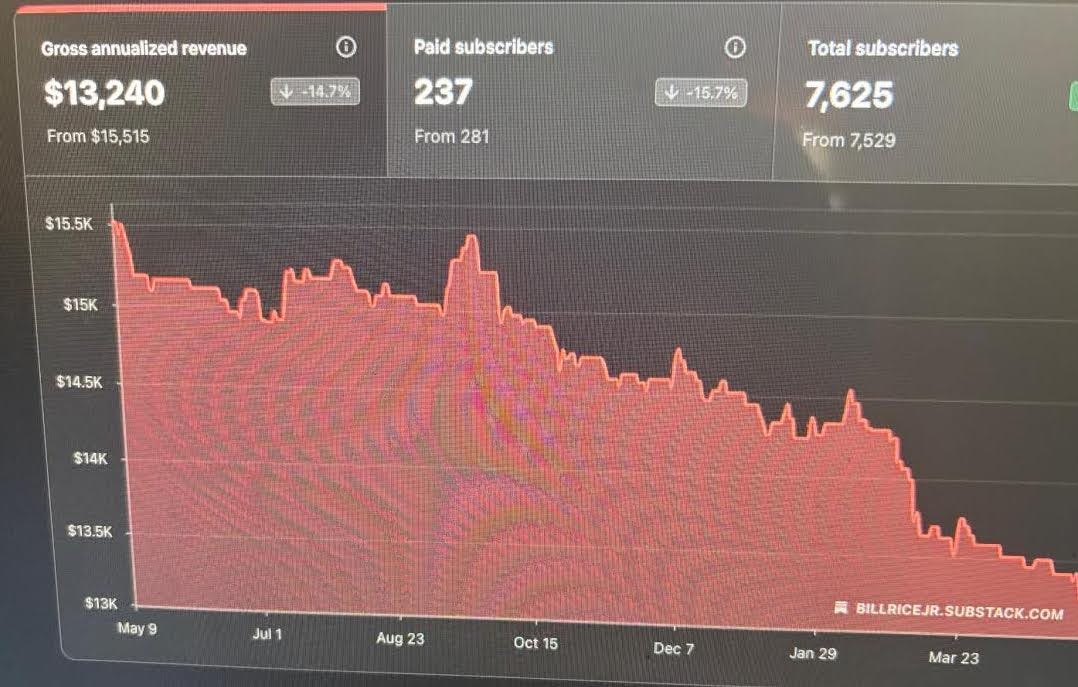
On the home page of author’s dashboards, Substack provides its content creators a numeric and graphic snapshot of the author’s “Gross Annualized Revenue.” Based on current paid subscriptions, this figure tells authors how much income they will generate in the next 12 months.
From this data, I know I am now losing thousands of dollars compared to revenue my newsletter once produced. While these figures were once growing, they now only decline.
My Gross Annualized Revenue Figure as of September 19, 2025 (7 3/4 months ago): $15,454
My Gross Annualized Revenue figure today (May 8): $13,240 (down 14.7 percent.)
I have, thus, lost $2,214 of gross income/revenue in the past eight months.
Why I think my newsletter ship is “sinking” …
Not only are the numbers of my paid and free subscriber numbers decreasing every month, the rate of this decrease is rapidly accelerating.
For example, not long ago, I was losing three paid subscribers every month; now I am losing six/month.
In the last 37 days - while (see below) Kait Justice’s subscriber numbers were exploding - I’ve, on average, lost 7.6 lost subscribers every day.
If I continue to lose six paid subscribers every month, I’ll lose 72 more paid subscribers by next May. However, since this attrition rate is now clearly accelerating, it seems certain I will have lost at least 100 paid subscribers 12 months from now. If the afore-mentioned inflation bomb hits, I will probably fall under 100 paid subscribers in a year - which would be more than 200 fewer than I had at my peak (310) approximately 18 months ago in October 2024.
Also, my Substack “gross annual income” will have fallen from approximately $18,000 to probably under $6,000.
At some point, a tipping point will occur and I will have no choice but to enter the “real world” job market to ensure the bank doesn’t foreclose on our home and that we can keep paying the electric bill, which is probably NOT going to go down.
(As I’ve noted, due to my “contrarian” bonafides, I already know I’m unemployable as corporate journalist, meaning I’m going to cross my fingers that Wal-Mart or Dollar General might hire me).
On the positive front - as an inflation work-around- my wife recently started a “pet-sitting service” and I could perhaps help Carrie grow this new business. (Alas, with rapidly-accelerating fuel and inflation prices, it’s likely fewer citizens will take vacations or travel long distances and, thus, won’t need a pet sitter).
The Grass is Greener on the Other Side of Substack …
To myself, the most “curious” conclusion I’ve made from examining Substack metrics of more liberal or narrative-protecting Substack authors is that this ever-expanding cohort of independent writers has been doing fantastic … since, approximately 2024.
That is, during the same time span my numbers have been circling down the drain, the numbers of more liberal authors have been soaring through the penthouse.
(Per my research, Substack as a media platform has been experiencing “exponential” growth, a growth spike that seems to trace back to the hotly-contested presidential election season of 2024. However, these growth metrics do not seem to be evenly distributed, which makes me wonder if ideology (or the potentially “thermo-nuclear” content I sometimes highlight) might also have played a role in my dramatically different metrics.
For example, per this Hollywood Reporter story from March 2025, the total number of Substack paid subscriptions increased from 4 million to 5 million in just four months between late 2024 and early 2025.
Kait Justice symbolizes the opposite side of the spectrum …
Newsletter author Kait Justice, who has found a very lucrative niche combing
through the Epstein files, illustrates the contrast between one group of Substack authors and myself.
Justice (a pseudonym) published her first Substack article on Oct. 6, 2025, when she had zero subscribers. Today, seven months later, Kait has more than 26,000 subscribers.
Furthermore, Kait now has at least 1,000 paid subscribers. (I know this since her newsletter now has a coveted orange check mark “badge,” which signifies an author with “thousands of paid subscribers.”)
Since Kait charges $80 for an annual paid subscription, she is now grossing at least $80,000 year. (In recent posts, Kait has thanked her subscribers for allowing her to make enough money to perform her citizen journalism and research full-time. FWIW, reaching 1,000 paid subscribers was always my goal as well and, at one time, I was pacing to achieve this goal by the end of next year.)
The following numbers illustrate Kait’s impressive subscriber growth by dates …
Total Subscribers:
Oct. 5: 0
January 11: 3,600+
April 1: 17,000+
May 7: 26,000+
Note: When I profiled Kait’s newsletter on January 11, my newsletter had 7,906 total subscribers compared to her 3,600. (Four months ago, I had 4,306 more subscribers than Kait. Today, Kait has approximately 19,000 more subscribers than my newsletter. (My headline “A Star is Born” proved to be prescient).
Since April 1, Kait’s newsletter has been averaging 243 new subscribers every day. In the same 37-day time span, I have lost 281 net subscribers and am, thus, losing an average of 7.6 subscribers every day.
In Conclusion …
I should emphasize that I don’t begrudge Kait’s success as a Substack citizen journalist and simply present these figures to contrast with my own numbers. I would also add that, per my research, many “Contrarian” Substack authors seem to have experienced similar and dramatic metric changes in the past 18 or so months.
I should also add that, I guess, it’s not impossible that my own numbers could experience a hard reversal. Maybe my newsletter “ship” will be rescued by some dramatic and unforeseen turn of events. However, given the obvious trend lines of the past 18 months, I probably should be looking for a life boat about now.
***
(I also want my readers to know that I do occasionally add a new paid subscriber. For example, in the last 30 days two readers upgraded from free to paid, including one reader today. The numbers above are “net” figures, meaning I lost eight paid subscribers in the past 30 days but added two, which is a net decrease of six. All new paid subscribers - as well as free subscribers - are greatly appreciated - today more so than ever … And, I do enjoy my work!)
I find you newsletter valuable and I appreciate your insight into the COVID fraud, particularly your documentation of IMHO clear evidence of early spread strongly pointing to a US based source of deliberate or accidental leak as We recently discussed & the multiple potential nefarious motives behind it.
It puzzles me no end that independent/contrarian authors struggle, given the current voting trends.
I think that reflects thumbs on the scales in many manors, possibly by multiple bad actors.
I don’t think that I am in a position to move from free to paid, much as I would like to, as at the strong encouragement of my wife, I jettisoned a number of paid subscriptions about a year ago.
If my ship comes in, I will certainly help float your boat.
Hang in there; fight the good fight!
The sorts of people that spend 450/year on substack probably don’t worry about inflation.